







Blog
Oh, Tempelhof, How Far You Have Risen
Nov
by

I know that fairy tales usually begin with “Once upon a time.” This story is not a fairy tale.
Once upon a time, in the 1930s, there was a master plan for Berlin, Germany. It was never realized, except for one item on the plan – one of the largest airport terminals in the world. Remember, air travel was in its infancy. A small terminal, four walls and a roof, would have sufficed.
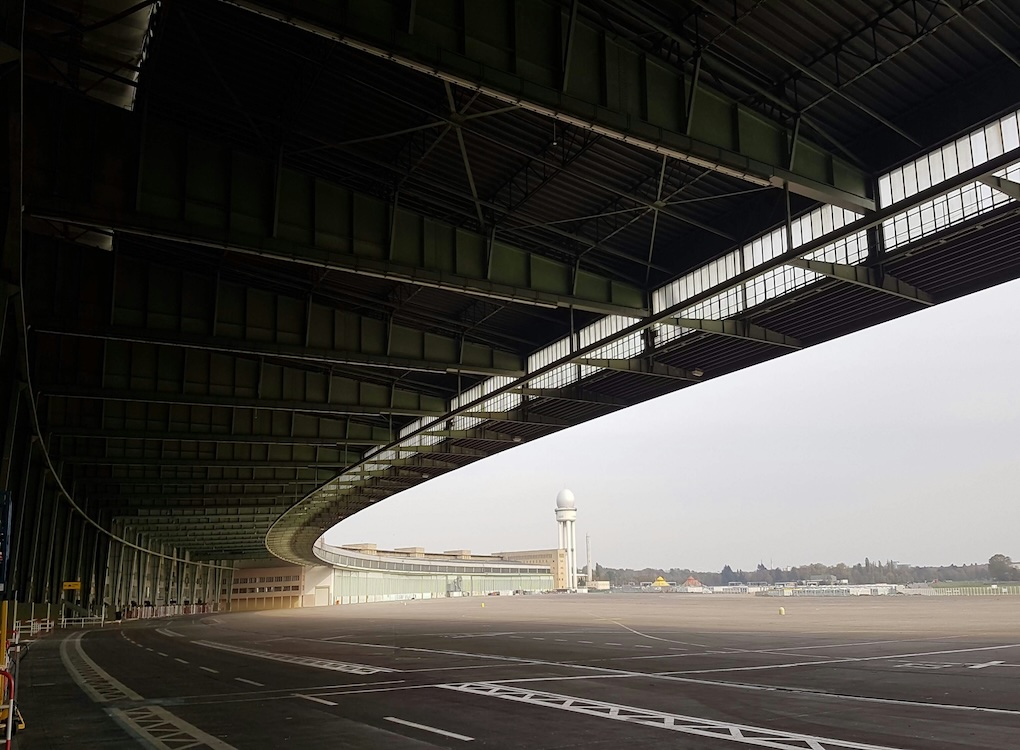
The Nazis intended it to be a gateway to a Nazi-inspired mega-city. The domed central structure could hold over 180,000 people. It was 300 metres tall and 250 metres wide. World War II stalled further construction, but the airport had already been built. The central terminal building is an arc 1.3 km in length. The materials used were meant to last 1,000 years. There was a canopy 380 metres long that planes could taxi under.
The overwhelming feeling one gets as you walk in and around this building is one of intimidation and awe – just what the architects were going for. All of this was above ground.
Underneath were tunnels and bunkers – reinforced walls, blast doors, a decontamination room, and emergency ventilation systems. There were civilian bunkers as well. Three hundred rooms, in fact, with 20 people to a room.
In 1941, construction was halted as resources were needed elsewhere to aid the war effort.
Forced labour helped keep costs down throughout the construction.
After the war, Berlin was divided, and Tempelhof was in the American Sector. The Americans quickly remodelled and built a basketball court and a bowling alley.
Then came the Soviet blockade of West Berlin during the Cold War. There was no road or rail access to West Berlin. Tempelhof became the daily receiving site for 5,000 tons of food and supplies for 2.5 million people. During peak periods, planes landed every 90 seconds.
Tempelhof transitioned from a symbol of oppression to a well-lit beacon of hope.
In the 1970s, 5.5 million passengers passed through this airport annually.
In the 1990s, the airport was in German hands, and reality set in. Other airports had been built, and Tempelhof was slated for demolition.
But even non-fiction fairy tales can have their ‘buts.’
A citizens’ group, “100% Tempelhofer Feld,” eventually received 64% support in a referendum to halt any future construction on the airfield.
A symbol of fascism became the world’s largest inner-city park. Over 235,000 people attended on opening day.
The mile-long rooftop of the terminal is now a gallery of history, exhibiting throughout the year.
Instead of razing Tempelhof to the ground, citizens raised it high to something that couldn’t have been imagined decades earlier.
Photo by Ikechi Iwenofu on Unsplash.
My appreciation goes out to Fred Mills at his ‘The B1M’ YouTube Channel
Please give this a bit of a think. Should historical and tangible symbols of evil be erased, torn down, or otherwise lost to time? What about buildings and statues? What about historical written records? What about Hollywood-style movies depicting the exploits of people who are generally considered evil? What about medical knowledge gained through torture and experimentation on prisoners?
Please comment: Comment below or send me an email with your bit of a think. I am curious about your thoughts.
If you enjoyed The Blog, please share it with others. Thanks.
And my thanks to St. Albert’s 50+ Activity Centre for making this Blog possible.
Volunteer Blogger
