







Blog
Analog / Millennial Behaviour
Dec
I am trying to age in a healthy way, both physically and mentally. One of those factors means taking advantage of technology in its broadest terms. Not all technology. But using technology that provides a net benefit to me in my everyday functioning.
One aspect noted among millennials is their eagerness to adopt the latest technology. They grew up with it. I had to grow into it. Very different. I still have to ask myself ‘What could go wrong?” before trying out the latest technology.
Fortunately, I have a curious spirit that nudges me to try new technologies. I am having a current example of this in the analog, or non-tech, world.
I decided that the time had come to make my own sourdough bread. I know I’m 5 years behind the home bread-making craze of the pandemic. Better late than never.
One resource I’ve grown to appreciate is YouTube. It used to be part of my ‘time well wasted’ kind of activity; cat videos and numerous ways humans enjoy risking life and limb. Over the last couple of years, I’ve used it for searching ‘how to…’, sort of like a visual Google search result.
I started slowly, then pushed along when I was trying to remove the cover from the bathroom fan, which I was sure needed a good cleaning. A few search terms, and there was the demo I needed to get the job done.
I took the same approach to make my sourdough bread. I already knew I needed a starter dough. I viewed a few videos from different people until I found one that seemed to make sense and was doable. I converted the transcript into a recipe that I could copy/paste into my digital recipe box.
But.
I wanted to use 100% whole wheat flour, but all the videos, including my recipe, used 100% white flour.
I used my favourite AI application, Perplexity, and asked, ‘What changes to my sourdough starter recipe do I need to make to switch the white flour to 100% whole wheat flour?’
It gave me a lot of background on the differences between the two flours, which led to logical changes in the amounts of water and the allowances for rising time. It recommended to use only a small portion of the whole wheat flour.
I still wanted as much whole wheat as I could squeeze into the dough. I asked myself, ‘What could go wrong?’ I started my first starter with 100% whole wheat. Getting the dough to look and feel like it looked in the video was part science, part art. That’s the analog side of this. I could feel the dough.
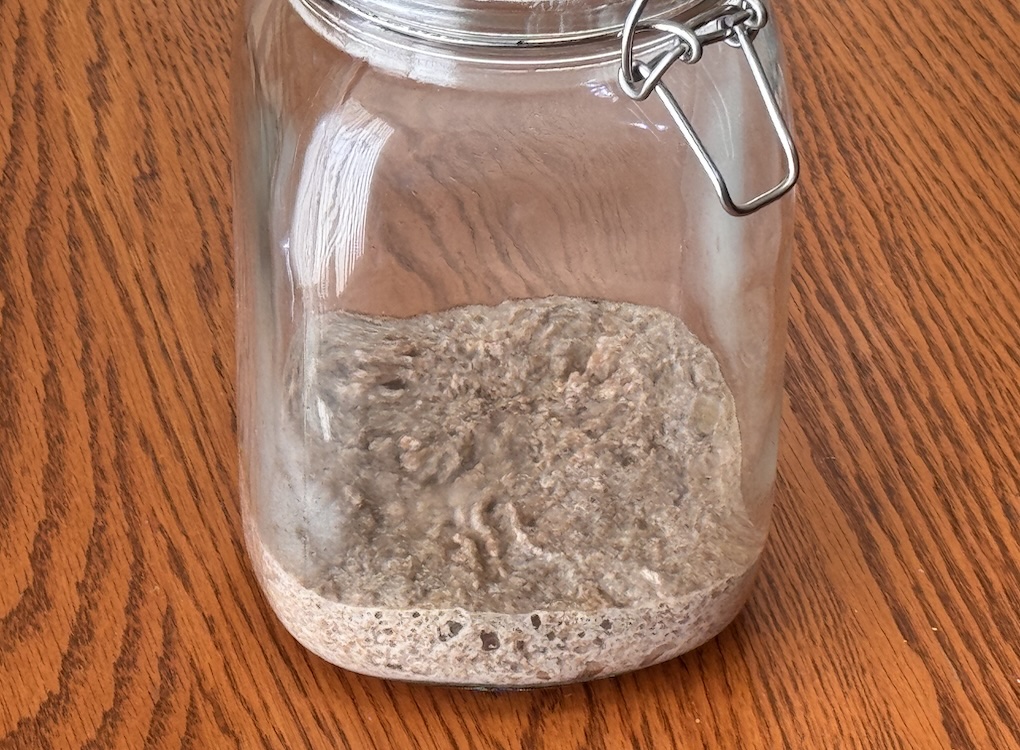
I was confident I had it right, so into the jar with the air-tight seal it went. It should finish bubbling by the end of the second day, possibly early on the third day.
I couldn’t wait, so I checked it after 24 hours. Nothing. Then after 48 hours. Nothing. I knew it might take longer, but so far, not a bubble. I checked it this morning, 72 hours after.
Glory be. Bubbles were forming along the edge of the glass.
This all started with a curiosity to learn how to do something I had never done before. Usually, this involves technology. This time, it was much more of an analog experience.
Please give this a bit of a think. What is something that you’ve accomplished, initiated partly by curiosity, and in part by ‘What could go wrong?’
Please comment by sending me an email with your bit of a think. I am curious about your thoughts.
Photo by Glenn Walmsley
If you enjoyed The Blog, please share it with others. Thanks.
And my thanks to St. Albert’s 50+ Activity Centre for making this Blog possible.

Volunteer Blogger
glenn.walmsley@icloud.com

Post with permission of the author, Patti:
They say “necessity is the mother of invention” but when our old washing machine started to shake, rattle and virtually roll, it was time to call the plumber . Turned out that the spring coil had become unhooked and it simply needed re-hooking The plumber wanted to show me how to do it in case it happened again – nice guy, it would save another service call.So I was invited to view it on my back under the machine lying next to him on the floor! This was really weird experience.
During the next washing load the same problem started up again and I promptly called the plumber. Well, seems like I needed a new spring coil.
I found one online for under $10 and my daughter who was 6 months pregnant at the time, shimmied under the machine while I assured her that no, I would not let it drop on her!
We were both elated – we fixed the washing machine.