








Blog
I Never Noticed It Before
Jan
by

I never noticed this, although it was hiding in plain sight.
Just pause reading this for a moment and look around you. Stop your look-around and pause on any doors you see. Yes, doors, and it doesn’t matter whether they are inside or outside. Do you see any doors with the familiar rectangular indentation?
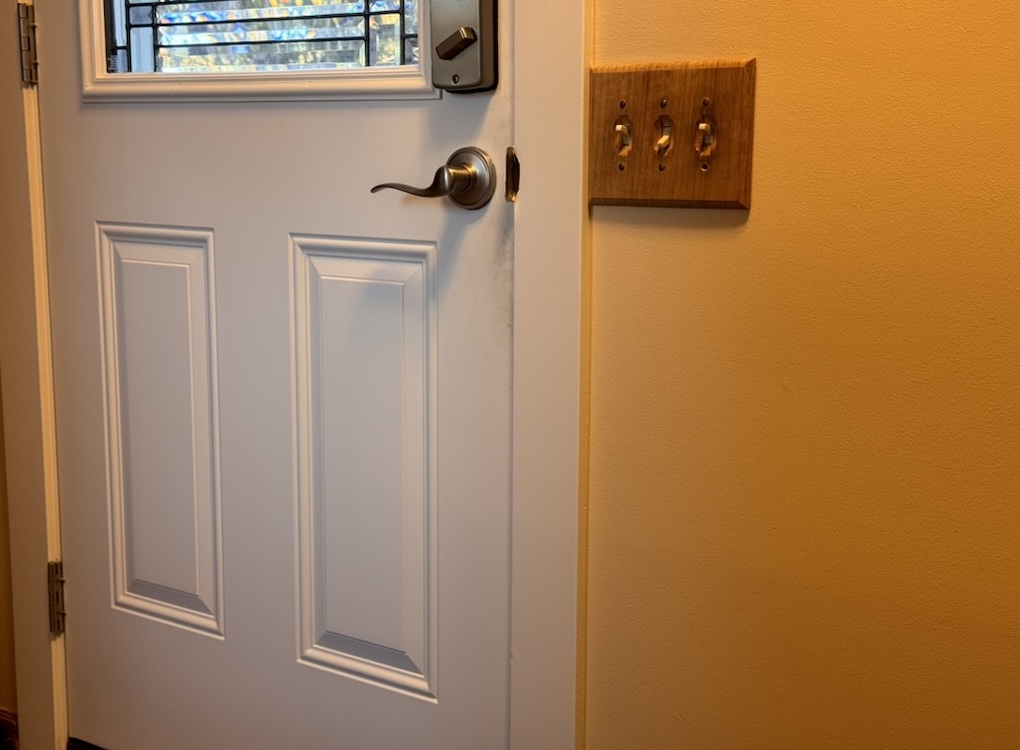
That’s what I never noticed before. I know not every door has them. Some are smooth. But as I glanced around my own home, there they were: the inside of my outside door (see the featured image), the neighbours’ garage doors. It seems that any doors that are not hollow or corrugated cardboard-reinforced have these indentations.
Why?
I’m glad you asked. I will put an end to your unrecognized misery.
Let’s start with the basics. The shape is called a raised panel. It didn’t start out as a decorative design. Wood doesn’t hold its shape well. It absorbs moisture, dries out, and warps. You get the idea.
Nailing wooden pieces together can help reduce these problems. However, there was still warping into a bowing shape. The lid was still square, but it no longer rested tightly on the trunk. Now imagine this problem with doors. A new solution had to be found.
Early carpenters found a solution. The door corners were glued and/or nailed, but the centre section was a large slide-in panel with pre-cut grooves. The door still warped because the panels were not attached to the main frame.
Why not create these raised panels and build them into a frame? Fewer expensive nails were needed, and it looked very attractive. The carpenter could charge more because it looked more attractive.
Follow the money.
The carpenters needed to create a slight bevel on these panels so they could be jammed into the frames. Over time, the bevels, with a few stylistic updates, evolved into the more familiar panels we see today.
But why do we still see them on doors that are not solid wood and on wall panelling? It’s purely about looks and cost. These jazz up a smooth-faced door. They can be made cheaply in moulded doors while selling for a premium price.
Light.
The whole panel is usually one colour. But, like a diamond, it has many reflective surfaces that show many shades of that one colour.
And there you have it. Enjoy your next walk through your neighbourhood, as you can’t resist looking at doors.
Or, tonight in bed, you might be awakened from a nightmare of raised panels jumping off your doors, zombie-like, to walk to the end of your bed.
Please give this a bit of a think. Are there patterns in your life that are so natural, you’ve never noticed the them? This often shows up in our decision-making. We can see it more easily in others. Why does my friend always pick bad friends? Why can’t I save any money like other people? Why can’t I lose weight? Why don’t I go to restaurants I’ve never been to?
Please comment by sending me an email with your bit of a think. I am curious about your thoughts.
If you enjoyed The Blog, please share it with others. Thanks.
And my thanks to St. Albert’s 50+ Activity Centre for making this Blog possible.
Volunteer Blogger
glenn.walmsley@icloud.com
